
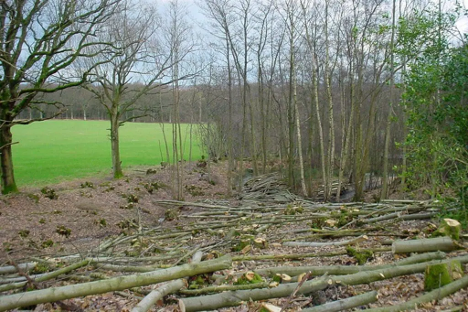
Firewood production is often a primary or secondary objective for many forest landowners. In many areas of the country, wood heat is an invaluable primary or supplemental heat source in cold winters. Firewood is typically harvested from large dead standing trees, or sold from lower diameter timber which doesn’t make grade. Firewood grown this way is perfectly fine for landowners with sufficient acreage or deep enough pockets to pay for firewood. But what about landowners with only a couple of acres? Or even less? This is where coppicing truly shines.
What is coppicing? Coppicing is a forest management technique formally developed in Europe wherein tree species which readily sprout are cut at the stump creating a “stool”. This stool then produces a profusion of small diameter stems which can be utilized for basketmaking, fencing, or in our case firewood. Poles can be harvested at rotation lengths which vary depending on the intended use case, but typically from 5 to 25 years. Stools can be harvested for hundreds of years if properly maintained. In Europe, this technique was developed to create maximum quantities of wood from minimal land area and inputs.
In the eastern United States, we are in the unique position of growing hardy species with dense, energy rich wood which grow quickly and establish easily. Red maple, black locust, and American sycamore are species which are easily grown from seed or volunteer on low quality sites. Many tracts of forest land which have been harvested have high densities of these species and aren’t valued highly due to a lack of marketable timber. However, this is the ideal canvas for creating a coppice which can provide fuelwood for households for many decades. Encouraging landowners to research and utilize this resource can help make energy independence more accessible to a wide variety of Americans.
Resources:
Ile, O. J. (2021, May 21). Coppiced American sycamore on marginal land as a viable short rotation woody crop. NC State Extension Publications.
Krawczyk, M. (2022). A cultural history of coppice agroforestry. In Coppice Agroforestry (pp. 15–64). chapter, New Society Publishers.
Santiago, R., Gallagher, T., Smidt, M., & Mitchell, D. (2016, September 21). Coppicing evaluation of short rotation coppice in the southeast of the U.S. to determine appropriate harvesting methods. US Forest Service Research and Development. https://research.fs.usda.gov/treesearch/55060
Photo credit:
Photo from New Society Publishers https://newsociety.com/blog/2022/06/05/what-is-coppice/?srsltid=AfmBOopXOYXIolmIGxqjKgvWySrHedvYttypSzChbMIHL4rVLCLvvora
