
Wood-boring insects are anything but boring! Every organism on the planet has evolved a way of exploiting a particular resource. By hiding under the bark of trees, these insects have found a way to protect themselves from the outside world and feed on an under-exploited resource: the tree’s “circulatory system.”
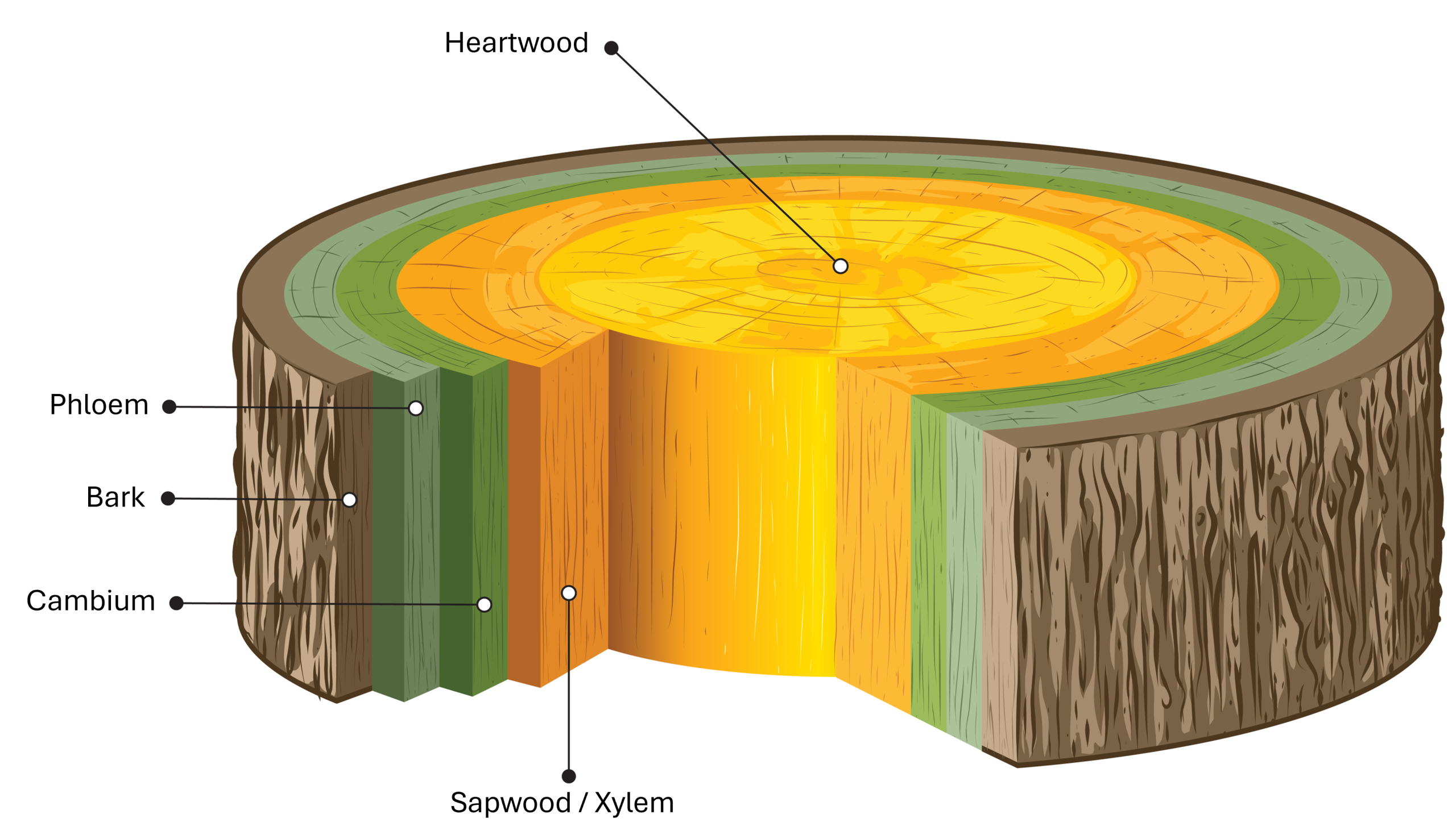
Leaves are responsible for photosynthesis, the process by which plants transform CO2, water, and light into chemical energy in the form of sugars. The plant sends the sugars from the top of the plant to the roots through a vascular system called phloem. While the roots absorb moisture and minerals from the soil and is carried to the canopy and stored by internal “pipes” called xylem. In between the phloem and the xylem lies the cambium, a thin layer of cells in charge of the trunk’s growth. All this happens underneath the bark, as shown in the figure above.
Woodborers specialize in chewing through the phloem and the cambium and by doing it, they create winding tunnels called galleries that disrupt the flow of nutrients and water. When these galleries wrap around the circumference of the tree, they girdle it, preventing nutrients from getting to the roots and water and minerals from reaching the tree’s canopy. Of woodboring insects, beetle borers are the most common and they tend to attack stressed trees. Symptoms of these attacks include branch or canopy dieback, exit holes in the bark, and shoots or branches growing below dead portions or from the base of the tree. Heavy woodpecker activity is another common sign of woodborers, as these birds are incredibly efficient at finding insects under the bark.
Once woodborers infest trees, it is very difficult to save them, and they will need to be cut down, so the best management practice is prevention. Healthy trees typically resist infestations, particularly when they’re not experiencing stress from insufficient water. To avoid infestations, don’t move firewood from its source to prevent the transportation of these tiny killers to new areas.
References:
University of Maryland Extension. 2024. Borer Insects on Trees. https://extension.umd.edu/resource/borer-insects-trees/
University of Maryland Extension. 2024. Conifer Bark Beetles on Trees and Shrubs. https://extension.umd.edu/resource/conifer-bark-beetles-trees-and-shrubs/
Rebek, E. 2017. Woodborers. Oklahoma State University Extension. EPP-7326. https://extension.okstate.edu/fact-sheets/woodborers.html
Iowa State University Extension and Outreach. 2019. Tree Anatomy 101. https://naturalresources.extension.iastate.edu/forestry/tree_biology/101.html
Figure credit: Modified from Cloud-Walker, Shutterstock
