
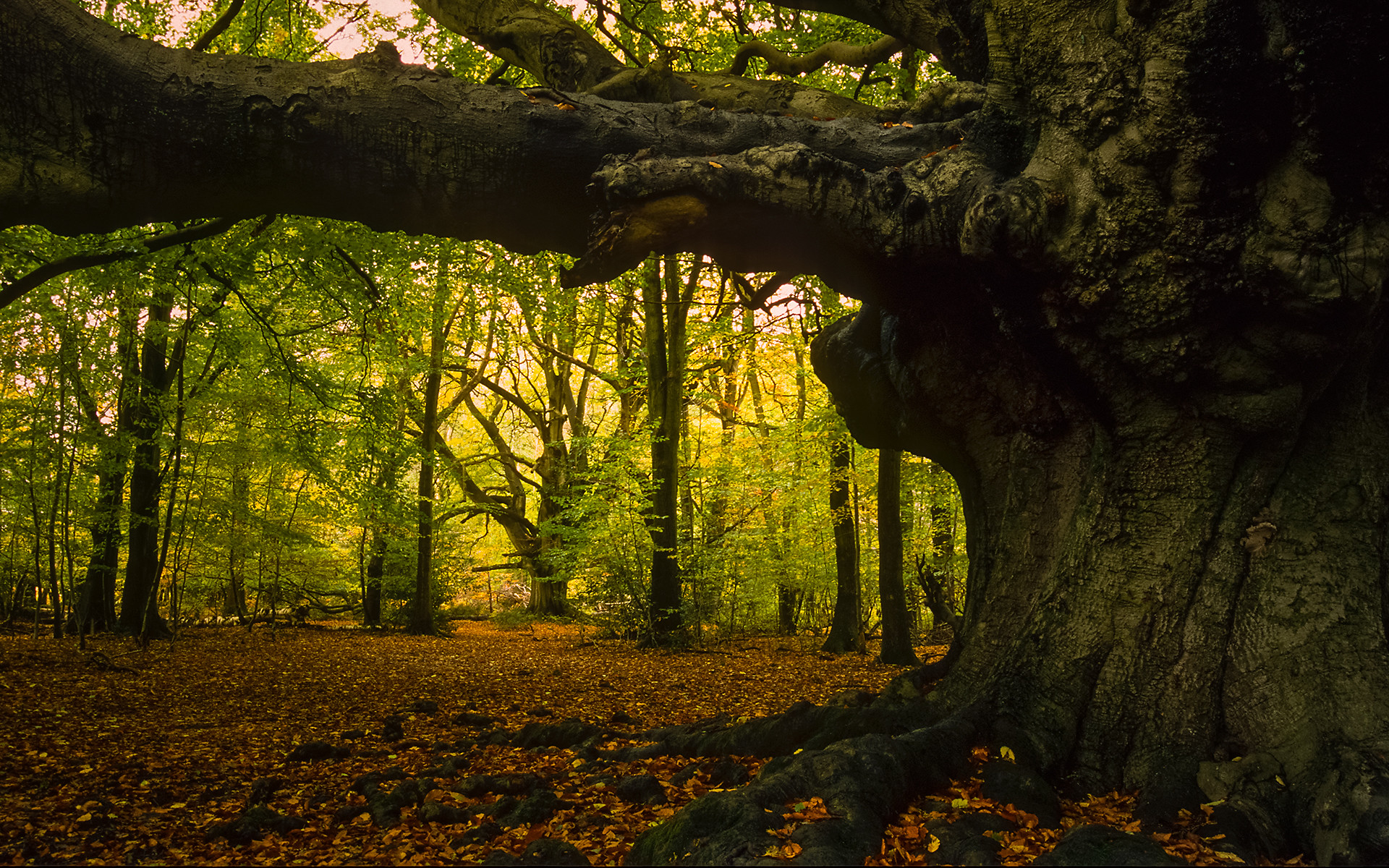
Close-grown forest trees grow tall and slender, shedding lower branches as they are shaded by neighbors, producing straight trunks and narrow crowns. Conversely, open-grown trees, free from competition for sunlight, develop massive trunks, sprawling crowns, and large lateral branches. Throughout Maryland’s forests, astute observers may occasionally encounter an older, much larger tree that stands out from its neighbors. These distinctive individuals – marked by large, spreading branches and notably broad crowns among otherwise uniformly narrow canopies – are known as “wolf trees.”
This term reflects outdated forest management philosophies framing these trees as overly competitive – likened to wolves that overhunt game and prey on livestock. In the early 20th-century, wolf trees were considered undesirable and often removed because their expansive crowns were thought to monopolize light, water, and nutrients that could otherwise support straighter, more commercially valuable timber. Today, this perspective has shifted significantly, and wolf trees are increasingly appreciated for their immense value.
Wolf trees serve as clues to past land use, revealing former open conditions that predate the surrounding forest. In Maryland, their presence often indicates land that was once cleared for pasture, agriculture, or homesteads. They act as living records of our state’s agricultural history and patterns of reforestation, illustrating how human activity shapes landscapes over many years.
Wolf trees are also vital ecological assets. Their large, complex structures provide significant habitat for birds, insects, and mammals, supporting biodiversity. Often long-lived, they also function as notable carbon reservoirs, accumulating carbon in woody biomass and root systems over the course of many decades – or even centuries!
Once dismissed as wasteful, wolf trees are now recognized as storytellers of the land and pillars of healthy forests. When exploring Maryland’s woods, look out for a tree that doesn’t quite fit in – older and more sprawling than its neighbors. You may have found a wolf tree silently bearing witness to the land’s history.
References:
Alex. (2019, February 26). What is a wolf tree? Why it matters in forest ecosystems. Heritage Conservancy. https://heritageconservancy.org/defining-our-landscapes-what-is-a-wolf-tree/ .
Crick, J. (2015, December 15). Wolf trees provide insight into the history of the land. Michigan State University Extension.
Gaige, M. (2014, October 28). Wolf trees: Elders of the eastern forest. American Forests. https://www.americanforests.org/article/wolf-trees-elders-of-the-eastern-forest/.
Open grown trees. People’s Trust for Endangered Species. (2018, March 13). https://ptes.org/campaigns/wood-pasture-parkland/wildlife/open-grown-trees/ .
Russell, M. (2020). Carbon in Minnesota Trees and Woodlands. University of Minnesota Extension.
Photo Credit:
Photo by UKGardenPhotos on Flickr. https://www.flickr.com/photos/ukgardenphotos/10172925104/in/album-72157636361979955
